







If you want a faster card game with real decisions on every turn, rummy rules 7 cards style is the answer. This guide covers setup, valid melds, scoring, and winning strategy for home play and online sessions at Lucky Tiger Casino.
Seven-card Rummy deals each player seven cards instead of thirteen, cutting round length while keeping the strategic core intact. The format suits tight schedules, rounds finish in under 20 minutes, and the rules take one session to learn well.
With only seven cards, every draw either closes a meld or forces a tough discard with no room to stall. Online platforms favor this version over the 13-card format for exactly that reason.
One 52-card deck covers two to four players; five players need two decks shuffled together to prevent the draw pile from running dry. Two-player games are sharp reading duels, while larger groups produce a busier and more information-rich discard pile.
The winner is the first player to arrange all seven cards into valid melds and go out, called going Rummy. Any card outside a meld becomes deadwood and converts into penalty points for everyone else at round's end.
Knowing 7 Card Rummy Rules means understanding every step from the opening deal to the final discard. Play is strictly turn-based with no passing, and agreeing on house rules for jokers and knocking before the first hand prevents disputes from arising mid-game.
Seven cards go to each player one at a time, clockwise, with remaining cards forming the face-down draw pile. The top draw-pile card is flipped face-up to start the discard pile, and the player to the dealer's left opens the first turn.
Each turn requires two steps: pick up from either the face-down draw pile or the face-up discard pile, then release one card from your hand. This drawing and discarding cycle repeats until one player melds all their cards and closes the round.
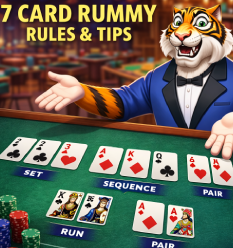
Melds (sets and sequences) take two forms: a set is three or four cards of the same rank in different suits, and a sequence is three or more consecutive same-suit cards such as 6-7-8 of hearts. Jokers and wild cards can substitute for any missing card in either type.
A pure sequence is a same-suit consecutive run built from natural cards only, with no joker filling a gap. Most rule sets require at least one pure sequence before a legal go-out; declaring without one is an invalid declaration and typically triggers a point penalty.
Anyone learning rummy rules 7 cards quickly discovers it runs on a penalty system: the winner scores zero while everyone else counts their unmatched deadwood. Face cards cost 10 points each, sessions end when any player crosses the agreed target (usually 100 points), and the lowest total wins.
|
Card type |
Point value |
Example |
Impact on score |
|
Ace |
1 point |
A of spades |
Low risk if unmatched |
|
Number cards 2-10 |
Face value |
7 of hearts = 7 pts |
Moderate risk |
|
Jack |
10 points |
J of diamonds |
High penalty |
|
Queen |
10 points |
Q of clubs |
High penalty |
|
King |
10 points |
K of spades |
High penalty |
|
Joker (unmatched) |
0 or 50 pts |
Depends on rules |
Varies by ruleset |
Joker penalty rules vary by group, so always confirm before play. Understanding these weights turns every discard decision into a deliberate move rather than a guess.
Deadwood is every card outside a valid meld when the round ends, and three unmatched face cards already equal 30 penalty points in a 100-point game. Actively reducing deadwood every turn, not only when you are close to going out, is what separates experienced players from beginners.
The player who goes out records zero; all others count unmatched card values and log the total to the scorecard. Play continues through additional rounds until someone crosses the target, and the player with the fewest accumulated penalty points wins the full session.
Consistent results require the right priorities from turn one and accurate opponent reading throughout every hand. Rummy rules 7 cards leave minimal margin for error, so developing active card-picking strategy from the start is what separates consistent winners from those who rely on luck.
You cannot go out legally without a pure sequence, so target one before any other meld. Hold cards moving you toward a same-suit run and discard everything pulling you away; once it is locked in, shift to a second meld and start cutting deadwood.
💡 If a face card is not within one draw of completing a set, release it immediately. Each unmatched King, Queen, or Jack costs 10 penalty points, and players who wait too long for the matching third rank consistently carry the heaviest deadwood totals.
If a player picks up a 9 of clubs, they likely need the 8 or 10 of clubs, so withhold those cards deliberately. This card-picking strategy also works defensively: throwing cards opponents have already discarded is always the safest discard available on any given turn.
A 7 fits a 5-6-7 or 7-8-9 run and also qualifies for a set of three 7s, offering multiple uses where a King or 2 offers just one. Holding middle cards while releasing face cards is the stronger early-game exchange across all rummy variations.
Knocking lets a player end the round early before anyone goes full Rummy, provided deadwood sits at or below the threshold, usually 10 points. Once you understand rummy rules 7 cards deeply enough to apply the knock option consistently, your win rate in competitive play improves noticeably. This mechanic adds calculated risk to every hand and knowing when to use it clearly separates intermediate from advanced players.
Eight points of deadwood against opponents likely holding 20-plus is a clearly profitable knock call, so act on it rather than waiting for a cleaner hand. Timely knocking is controlled aggression that wins more rounds than passive patience in most competitive settings.
A player who has not discarded any face cards in four turns is probably holding at least two of them, meaning 20-plus penalty points. Points calculation in competitive play is always about the gap between your score and your opponents', not your own total in isolation.
Chase a zero-deadwood declaration only when you are one card away and the draw pile still has depth. The standard rule is to knock at 10 points or fewer unless you are genuinely one draw from going Rummy, because an opponent going out first can cost more than a perfect finish is worth.
Home games and digital platforms each have a clear role in 2026, and platforms like Lucky Tiger casino provide 24/7 access with automated scoring and certified-fair shuffling. The core rules of rummy 7 cards stay identical in both formats, but pace, learning resources, and social atmosphere differ in ways worth considering before you choose where to play.
|
Feature |
Live home game |
Online app play |
Winner |
|
Speed of play |
Slower, social |
Fast, automated |
Online |
|
Opponent access |
Your group only |
Global player pool |
Online |
|
Rule flexibility |
High (house rules) |
Fixed by platform |
Live |
|
Learning resources |
Trial and error |
Built-in tutorials |
Online |
|
Shuffle fairness |
Manual, variable |
RNG-certified |
Online |
|
Social interaction |
High |
Lower |
Live |
|
Availability |
Scheduled only |
24/7 access |
Online |
Online play delivers more hands per hour, accelerating skill development faster than any home schedule. Home games win on atmosphere and the freedom to agree on custom house rules before the first card is dealt.
Most new players repeat the same errors when they first ask what are the rules for 7 card rummy?: holding wrong cards too long, revealing hand information through careless discard habits, and mishandling the final move that closes the round. Fixing just these three habits produces an immediate improvement in results at any table.
If the matching face card has not appeared by draw three, release those cards and move to a more reachable meld. Each unmatched face card costs 10 points, so carrying two or three of them to round's end is almost never worth the wait.
Use the face-down draw pile as your main source and take from the discard pile only when a card completes an immediate meld. Keeping your hand structure private is a genuine competitive edge that costs nothing to maintain throughout the game.
Even with all seven cards in valid melds, you must still discard one card to close your turn legally; skipping this step is an invalid declaration in most versions and triggers a penalty. Always finish every turn with a discard, especially when the win feels already secured.




































































.png)
















 slots.png)










.png)












.png)













.png)






































.png)