







Mastering poker hand rankings separates winning players from those who constantly second-guess themselves at showdown. This guide covers every combination from the unbeatable Royal Flush to the basic High Card, including tie-breaker rules and kicker mechanics. At Lucky Tiger, understanding hand card rankings eliminates confusion and speeds up your decision-making at the felt.
The best poker hands hierarchy creates a universal language ensuring every player knows exactly who wins each pot. Without a clear poker order, determining winners would be impossible across Texas Hold'em, Omaha, or any other variant played in the USA.
A standard deck contains 52 cards divided into four suits: hearts, diamonds, clubs, and spades. Each card hand rankings suit holds 13 ranks from 2 (the lowest) to Ace (the highest in most scenarios). When you combine these elements, you get thousands of possible five-card arrangements. The beauty of poker lies in how these arrangements translate into winning combinations that determine the outcome of every showdown.
No matter how many cards you hold or how many community cards appear on the board, only five cards count toward your final hand. In Texas Hold'em, you pick the best five from seven available cards. In Omaha, you must use exactly two from your hole cards and three from the board. This universal five-card principle keeps the casino game consistent across all formats and ensures that poker combinations remain comparable.
Here's a common card hands misconception: many beginners assume that spades outrank other suits. In reality, no suit holds more power than another during standard play. Hearts, diamonds, clubs, and spades are all equal when determining who wins a pot. Suits only come into play in specific scenarios, like deciding the bring-in for Stud games or breaking ties for the button in tournaments. For showdown purposes, forget about suit superiority entirely.
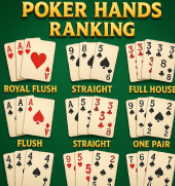
Now let's examine the best hands poker in descending order. Memorizing this list is essential for every level of player. Once you know where each combination sits in the poker hands order, you'll make faster decisions and avoid costly mistakes. Each entry below includes what cards you need and why that hand holds its particular rank.
The royal flush consists of A-K-Q-J-10 in identical suits. Only four exist in any standard deck, making it astronomically rare and completely unbeatable.
A straight flush requires five consecutive cards sharing one suit. The top card determines strength when comparing two straight flushes against each other.
Four of a kind means holding all four cards of identical rank. Quads crush everything beneath them and rank among the most celebrated hands of poker.
A full house pairs three cards of one rank with two of another. The three-of-a-kind portion determines winner when comparing full houses—10-10-10-2-2 beats 9-9-9-A-A.
A flush requires all five cards sharing a suit regardless of sequence. The highest card decides between competing flushes—ace-high beats king-high every time.
A straight needs five consecutive ranks in mixed suits. Aces work as highest (A-K-Q-J-10) or lowest (A-2-3-4-5). Good poker hands like straights win frequently at most tables.
Three of a kind features three matching ranks plus two unrelated cards. A "set" comes from pocket pairs hitting the board; "trips" forms from one hole card matching two board cards.
Two pair combines two different pairs with a fifth card. Higher pair evaluates first, then second pair, then kicker for determining winners between identical holdings.
A pair contains two matching ranks alongside three unrelated poker card hands. Pairs appear constantly and win plenty of small to medium pots.
When nobody makes a combination, the high card rule applies. The person holding the highest individual card claims the pot, comparing downward until differences emerge.
|
Rank |
Hand name 🃏 |
Cards required |
Example 🎴 |
Rarity/Odds 📊 |
|
1 |
Royal Flush |
A-K-Q-J-10 same suit |
A♠ K♠ Q♠ J♠ 10♠ |
1 in 649,740 |
|
2 |
Straight Flush |
Five sequential, same suit |
5♥ 6♥ 7♥ 8♥ 9♥ |
1 in 72,193 |
|
3 |
Four of a Kind |
Four cards, same rank |
9♦ 9♣ 9♠ 9♥ K♠ |
1 in 4,165 |
|
4 |
Full House |
Three of a kind + pair |
J♣ J♠ J♦ 4♥ 4♣ |
1 in 694 |
|
5 |
Flush |
Five cards, same suit |
A♦ J♦ 8♦ 6♦ 2♦ |
1 in 509 |
|
6 |
Straight |
Five sequential, any suit |
3♠ 4♦ 5♥ 6♣ 7♠ |
1 in 255 |
|
7 |
Three of a Kind |
Three cards, same rank |
7♥ 7♦ 7♠ K♣ 2♦ |
1 in 47 |
|
8 |
Two Pair |
Two different pairs |
Q♠ Q♦ 5♣ 5♥ A♦ |
1 in 21 |
|
9 |
One Pair |
Two cards, same rank |
10♣ 10♥ A♠ 8♦ 3♣ |
1 in 2.4 |
|
10 |
High Card |
No combination |
A♥ K♦ 9♠ 7♣ 4♦ |
1 in 2 |
Even when two players hold seemingly identical hands, someone usually wins. The rules for breaking ties ensure that pots go to the rightful winner rather than being split unnecessarily. Understanding these mechanics prevents confusion and keeps the game moving smoothly.
Imagine both you and your opponent hold a pair of jacks. Who wins? The answer lies in the remaining three cards. Whoever holds the highest cards beyond the pair claims the pot. This comparison continues until a difference emerges or all five cards match exactly.
A kicker is simply any card that doesn't contribute to your primary combination but helps determine winners in close situations. If you have A-A-K-7-3 and your opponent shows A-A-Q-9-5, your king kicker beats their queen. Kickers apply to pairs, two pairs, three of a kind, and even four of a kind in rare scenarios.
💡 Always consider your kickers when deciding whether to enter a pot. A pair of aces with a king kicker plays much better than aces with weak side cards.
Sometimes both poker hand rankings players construct the exact same five-card hand using community cards. In Texas Hold'em, this happens when the board plays itself or when both players' hole cards are irrelevant to the final hand. In these cases, the pot splits evenly between all tied players.
|
Situation 🤔 |
Player A hand 🅰️ |
Player B hand 🅱️ |
Winner 🏆 |
Why? 💡 |
|
Same pair, different kicker |
A-A-K-8-4 |
A-A-Q-J-9 |
Player A |
King beats Queen kicker |
|
Identical two pair |
K-K-7-7-A |
K-K-7-7-A |
Split pot |
All five cards match |
|
Same trips, different kicker |
5-5-5-A-2 |
5-5-5-K-Q |
Player A |
Ace kicker wins |
|
Board plays itself |
Both hold low cards |
Board shows A-K-Q-J-10 |
Split pot |
Best hand is on board |
|
Flush comparison |
A♥ J♥ 8♥ 5♥ 2♥ |
K♥ Q♥ 9♥ 6♥ 3♥ |
Player A |
Ace-high beats King-high |
Not every game follows the exact same poker cards ranking structure. While the core hierarchy remains consistent, certain formats introduce wrinkles that can catch unaware players off guard. Let's explore the key differences you might encounter.
Both games use identical rankings for the best hand in poker. The difference lies in how you construct your hand. Hold'em lets you use any combination of hole cards and community cards. PLO requires exactly two hole cards plus exactly three board cards. This rule often confuses new Omaha players who forget they can't play four to a flush from the board.
Short Deck removes all cards below 6, leaving just 36 cards in play. This dramatically changes probabilities and, consequently, rankings at some venues. In most Short Deck games, a flush beats a full house because flushes become harder to hit with fewer cards per suit. Additionally, three of a kind often beats a straight. Always verify house rules before playing this variant.
Some poker formats flip the hierarchy entirely. In games like Razz or 2-7 Triple Draw, the lowest hand wins rather than the highest. Aces typically count as low, and straights/flushes either don't count against you or count against you depending on the specific game. This inversion requires completely different strategic thinking.
✅ Advantages of learning multiple variants:
❌ Potential pitfalls:
Numbers don't lie. Understanding the mathematical likelihood of making certain hands helps you make better betting decisions. While you don't need to memorize every statistic, knowing the basics separates informed players from those flying blind.
Your chances of receiving a royal flush as your initial five cards are approximately 1 in 649,740. In Texas Hold'em specifically, where you build from seven cards, the odds improve slightly to about 1 in 30,940 over the full hand. Either way, don't hold your breath waiting for one. When it arrives, savor the moment.
At first glance, many assume a full house should be more common than a flush because it uses mixed ranks and suits. However, the math tells a different story. With a standard deck, there are fewer ways to combine three cards of one rank with two of another than to assemble five non-sequential cards of the same suit. That's why full houses rank higher in the poker order hierarchy.
If you start with a pocket pair in Hold'em, you'll flop a set roughly 12% of the time (about 1 in 8.5 attempts). If you hold two suited cards, you'll flop a flush around 0.8% of the time. A flush draw on the flop gives you approximately 35% equity to complete by the river. These numbers should inform how aggressively you pursue draws.
💡 Practical tip: Don't chase unlikely draws without proper pot odds. Knowing your percentages helps you determine whether calling makes mathematical sense.
Theory means nothing if you can't apply it in real-time. Developing mental shortcuts and using available tools helps you process information faster. At Lucky Tiger, several resources exist to support your decision-making during actual sessions.
Many online platforms offer visual aids that display your current hand strength or suggest likely holdings. These tools work by analyzing board texture and calculating probabilities instantly. While they can't play for you, they reinforce learning and help beginners build intuition faster.
When starting out, create a simple mental checklist:
A flush ranks fifth overall but crumbles against full houses on paired boards. Context matters—betting patterns and opponent tendencies transform pure rankings into profitable reads.





































































.png)
















 slots.png)










.png)












.png)













.png)







































.png)