







Pile Up Poker merges solitaire patience with poker excitement, challenging players to build winning hands across a 4×4 grid. This hybrid gameplay rewards forward thinking and careful card positioning. Each session tests your ability to balance multiple scoring opportunities simultaneously. Whether you prefer puzzles or card games, this guide covers rules, strategies, and advanced techniques for maximizing your score.
This innovative format blends two classic card game styles into one brain-teasing challenge. Strategic placement determines success as you arrange cards to form valuable combinations across rows, columns, and special positions.
The solitaire Pile Up Poker layout requires arranging cards on fixed positions while pursuing poker hand combinations that generate points. Every card placement impacts multiple potential hands simultaneously. Position an Ace in one corner, and it contributes to a row, column, and the diagonal corner hand, creating interconnected scoring zones.
Standard versions utilize a reduced 36-card deck, eliminating 2s through 5s entirely. This deck management approach increases strong hand frequency by compressing values into a tighter range. Straights become achievable more often, and pairs develop into three-of-a-kinds regularly.
Your goal involves maximizing point accumulation across all scoring opportunities. The grid produces four horizontal rows, four vertical columns, plus the corner hand and discard pile hand, totaling ten scoring positions requiring balanced attention.
Understanding the basic flow helps newcomers get comfortable quickly. Each round follows a predictable pattern, but the strategic depth emerges from how you respond to the cards dealt. The stacking mechanics differ from traditional poker since you're building multiple hands simultaneously rather than competing for a single pot.
Each round delivers five face-up cards for evaluation. This visibility enables planning and comparison before committing. Examine all five cards, identifying potential straights, flush opportunities, or pairs that could strengthen.
From five cards, four enter the grid while one joins the discard pile. Strategic placement matters enormously since incorrect positioning blocks future opportunities. Consider which rows and columns need specific values before locking anything.
💡 When holding same-suit cards, place them in a single row or column to build toward flushes.
Once positioned, cards remain permanently fixed. This permanence elevates decision stakes considerably. The card sorting mechanism encourages thorough analysis before acting rather than impulsive placement.
The playing area contains 16 spaces in a perfect square. Corner spots belong to three different hands simultaneously, making them extremely valuable territory for clearing the board efficiently.
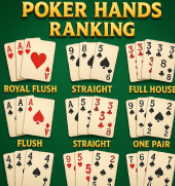
Points determine your final result, so understanding the scoring system is essential. Different hand types award different values, with rarer combinations paying significantly more. The point accumulation system rewards aggressive play toward premium hands while still providing modest returns for basic pairs.
|
Hand rank |
Point value ($) |
Difficulty |
Tip |
|
🃏 High card |
$0 |
⭐ |
Avoid entirely |
|
✌️ One pair |
$100 |
⭐ |
Build toward trips |
|
✌️✌️ Two pair |
$300 |
⭐⭐ |
Solid baseline |
|
🎯 Three of a kind |
$600 |
⭐⭐ |
Strong foundation |
|
📈 Straight |
$1,200 |
⭐⭐⭐ |
Bread-and-butter scorer |
|
♠️ Flush |
$1,400 |
⭐⭐⭐ |
Track suits carefully |
|
🏠 Full house |
$2,000 |
⭐⭐⭐⭐ |
Combine pair with trips |
|
💎 Four of a kind |
$4,000 |
⭐⭐⭐⭐ |
Rare but rewarding |
|
👑 Straight flush |
$10,000 |
⭐⭐⭐⭐⭐ |
Ultimate achievement |
Two special hands carry multipliers boosting their value dramatically. The corner hand pays double, while the discard pile pays triple. Try poker Pile Up strategies prioritizing these multiplied positions early in your game.
The four corner positions combine into one special hand with a 2x multiplier. These cards also participate in rows and columns, delivering triple contribution value, making corners premium real estate.
The discard pile isn't just a dumping ground for unwanted cards. Thoughtful players treat it as a deliberate construction project, building toward high-value combinations that pay triple points upon completion.
Throughout gameplay, discards accumulate into a four-card pile scoring as the tenth hand with a 3x multiplier. A straight here earns $3,600 versus $1,200 on the main grid. This transforms the Pile-Up Poker experience entirely.
Early discards should support your pile strategy while remaining expendable from grid-building. Discarding randomly early creates incompatible piles incapable of forming hands later.
The discard pile only scores upon filling all 16 grid spaces. Failing forfeits those triple-multiplied points entirely. Practice with free Pile Up Poker versions to master completion strategies.
Current meta strategies have evolved as players share discoveries and techniques online. Try Pile Up Poker free versions to practice without pressure while developing your personal approach. The following tips reflect accumulated community wisdom about what actually works.
Balanced attention between rows and columns outperforms single-direction focus. Experiment with column-first approaches, finding horizontal connections form naturally as verticals fill.
Straights deliver excellent value ($1,200) while appearing consistently with the reduced deck. Multiple straights across your grid create reliable scoring foundations. Building these medium-difficulty combinations sustains competitive scores.
Open-ended draws provide flexibility since multiple card values complete your hand. Gutshots risk failure waiting for one specific card. Favor open-ended configurations when constructing hands on the Pile-Up Poker grid.
Understanding how puzzmo Pile Up Poker game differs from casino video poker helps players adjust their expectations and strategies appropriately. The comparison below highlights key distinctions.
|
Feature |
🧩 Pile-Up format |
🎰 Classic video poker |
🔑 Key difference |
|
🎮 Style |
Puzzle-based |
Draw-based |
Multiple vs. single hand |
|
🃏 Cards |
5 per round × 4 |
5 total |
More cards managed |
|
🎯 Hands scored |
10 simultaneous |
1 at a time |
Grid interconnection |
|
🔒 Movement |
Locked placement |
Exchangeable |
No repositioning |
|
📊 Skill factor |
Very high |
Moderate-high |
Placement dominates |
|
💰 Multipliers |
2x/3x available |
Usually none |
Special positions |
The hybrid gameplay suits optimization enthusiasts preferring interconnected variables over rapid-fire decisions.





































































.png)
















 slots.png)










.png)












.png)













.png)







































.png)