







Mastering the art of Double Down in Blackjack is one of the fastest ways to shift the mathematical edge in your favor. This move lets you increase your wager at the exact moment when probability supports aggression. Intermediate players who learn these patterns consistently outperform those who rely on gut feeling alone. Below, we cover every key scenario, provide a ready-to-use cheat sheet, and explain how to apply this knowledge during sessions at luckytigercasino.com.
At its core, this move allows you to place a second bet equal to your original wager after seeing your first two cards. In return, the dealer gives you exactly one additional card — no more, no less. What is Double Down in Blackjack in practical terms? It is a calculated commitment that locks your hand after a single draw, trading flexibility for a larger potential payout.
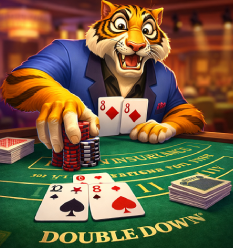
You push a second chip stack beside your original wager, receive one card face up, and your turn ends immediately. If you bet $15 and double, you now have $30 riding on that single draw. There is no option to hit again or change course — the decision is final the moment you signal it.
The strength of doubling lies in selective aggression. You increase exposure only when the expected value of one more card is positive — typically when your total sits near 10 or 11 and ten-value cards dominate the deck. Doubling at the wrong moment, however, simply doubles your loss. The optimal strategy demands discipline: double when math says yes, resist when it says no.
At a physical table, place your additional chips next to (never on top of) your original bet and hold up one finger. Online platforms display a dedicated "Double" button after your initial two cards appear. At digital tables like those on luckytigercasino.com, the process takes a single click — the interface handles the rest automatically.
Recognizing profitable moments forms the operational backbone of any disciplined Blackjack approach. Players who understand when to Double Down in Blackjack can significantly increase their long-term edge by capitalizing on situations where the starting hand is strong and the dealer’s upcard indicates weakness. These high-leverage moments create the most reliable opportunities for value, making their correct identification the most direct path to maximizing profit across hundreds of hands..
Hard 11 stands as the premier doubling hand in the casino game. Any ten-value card (10, J, Q, K) delivers 21, and these cards represent the largest single group in the deck. Double on 11 against every dealer upcard from 2 through 10 in standard multi-deck games — skipping this play consistently costs you money long-term.
A hard 10 ranks just behind 11 in doubling strength. Place the extra bet whenever the dealer reveals anything from 2 through 9, since your probability of reaching 20 remains high while the dealer faces bust or low-total risk. Against a dealer's 10 or Ace, simply hit — the edge vanishes when the dealer holds power cards.
With hard 9, the window tightens considerably. Double only against dealer's weak cards showing 3, 4, 5, or 6 — these upcards carry the highest bust probability. Against any other upcard, hitting is the correct play. Solid knowledge of when to act on hard 9, 10, or 11 forms the backbone of every reliable basic strategy table.
Soft totals include an Ace valued as 11, which effectively creates a built-in safety buffer because the next card cannot immediately push the hand over 21. This structural flexibility opens strategic opportunities that many casual players overlook. Learning when to Double Down in Blackjack on soft hands is a key element of disciplined play, allowing skilled players to capitalize on favorable situations and steadily increase expected value over time..
These starting totals are modest on their own, but the dealer's vulnerability compensates for your weaker position. Double when the dealer shows 5 or 6, as their bust rate on these upcards reaches roughly 42%. Even catching a small card leaves you competitive because the dealer is statistically likely to exceed 21.
Soft 16 and 17 warrant doubling against dealer upcards of 3 through 6. Soft 18 follows the same range — double versus 3 through 6 and stand against stronger cards. The Ace's ability to shift between 1 and 11 means a bad draw rarely destroys your hand, while a good draw can push you toward 21.
Soft 19 and 20 are already premium totals that win most rounds without intervention. Standing protects a near-certain victory, while doubling risks downgrading an excellent hand for marginal gain. Keep these totals intact and collect your winnings.
This quick-reference guide follows standard multi-deck rules and covers the situations you will encounter most often. Consult it during live or online play whenever you feel uncertain about the correct move. Bookmark this page or screenshot the table for instant access at the felt.
|
Your hand |
Dealer's upcard |
Decision |
Why it's profitable |
|
Hard 11 🔥 |
2–10 |
✅ Double |
Best odds of reaching 21 |
|
Hard 10 💪 |
2–9 |
✅ Double |
Strong total vs. vulnerable dealer |
|
Hard 9 🎯 |
3–6 |
✅ Double |
Dealer's high bust probability |
|
Hard 9 |
2, 7–A |
❌ Hit |
Dealer position too strong |
|
Soft 13–15 🃏 |
5–6 |
✅ Double |
Ace protects, dealer exposed |
|
Soft 16–17 🃏 |
3–6 |
✅ Double |
Flexibility + weak dealer |
|
Soft 18 💡 |
3–6 |
✅ Double |
Improvement likely, dealer busts |
|
Soft 19–20 🏆 |
Any |
❌ Stand |
Already winning totals |
|
Hard 12+ ⚠️ |
Any |
❌ Never double |
Bust risk far too high |
Avoiding bad doubles is equally important as executing good ones. Every incorrect double effectively donates extra money to the house, erasing gains from your well-timed plays.
When the dealer reveals an Ace or ten-value card, their probability of making 17–21 jumps dramatically. Blackjack Double Down attempts into this strength lose money in nearly every configuration. The sole exception is hard 11 versus a dealer 10, where doubling retains a slim positive edge.
Hard totals of 12 through 16 sit in the danger zone where a single ten-value draw causes a bust. Doubling here locks you into one card with significant bust risk and zero ability to recover. The correct approach with these hands is to hit or stand based on the dealer's upcard — never to double.
The DAs rule (double after split) affects pair-splitting decisions throughout your session. When table rules permit DAs, splitting certain pairs becomes more attractive because a favorable post-split total opens a doubling opportunity. Always verify this rule before sitting down, as house variations between tables can shift the correct play for several hands. When can you Double Down in Blackjack after a split? Only if the specific game explicitly allows it.
The online Blackjack environment continues evolving with new variants, adjusted payouts, and platform-specific rules. Staying competitive means adapting your decisions to current conditions rather than relying on outdated assumptions.
Doubling amplifies bankroll volatility directly — every double puts twice your base bet at risk on a single outcome. Keep your standard wager at 2–3% of your session budget so that doubles remain sustainable through natural variance. If three consecutive double-down losses would force you off the table, your base bet is too high.
💡Set a firm loss limit before each session. The math rewards patience over hundreds of hands, and you need enough chips to let the strategy deliver results.
Different titles at luckytigercasino.com operate with different deck counts, payout structures, and doubling rules. Some versions allow players to Double Down in Blackjack on any two starting cards, while others restrict this move to specific totals such as 9, 10, or 11. It is also essential to verify whether a natural Blackjack pays 3:2 or 6:5, since this single rule can significantly change the player’s expected return. Spending thirty seconds reviewing the table rules can protect your bankroll and save real money over the course of a full session.
Many players know the correct move intellectually but freeze when real money is at stake. Pushing a second bet forward triggers a natural loss-aversion response that overrides logic. Practice in free-play mode until Double Down Blackjack decisions feel automatic, then transition to real stakes with confidence — every skipped correct double costs you expected value that compounds over time.

















































.png)
















 slots.png)










.png)












.png)












.png)































.png)