







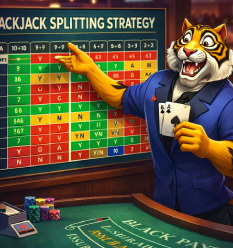
Mastering pair splits separates casual players from those who consistently beat the dealer. This decision doubles your action when conditions favor it, creating two winning opportunities from a single dealt hand. The Blackjack Splitting Strategy outlined here gives you exact rules for every pair against every dealer upcard. Understanding these patterns reduces the house edge significantly and puts more money in your pocket over time.
Splitting transforms one hand into two separate betting positions when you receive matching cards. Each new hand plays independently with its own outcome. The basic strategy matrix provides mathematically proven guidelines for exactly which pairs deserve this treatment.
Your dealer separates the paired cards and deals a second card to each new hand. You play the hands one at a time, making decisions for each independently. Knowing when can you split in blackjack means recognizing that any two cards of equal rank qualify for this option.
Splitting demands an additional wager matching your original bet. A $25 hand requires another $25 to split. Proper pairs management ensures you only split when mathematics supports the extra investment, never simply because the option exists.
Physical casinos require placing your second bet beside the original while holding up two fingers. Online platforms display a split button automatically when you receive qualifying pairs, making the process straightforward.
Four splitting decisions remain constant regardless of dealer upcard. These rules have been proven across millions of simulated hands.
Splitting aces and eights forms the cornerstone of pair Blackjack Splitting Strategy. A lone ace has approximately 30% chance of pairing with a ten-value card for 21. Two aces together make only 12, a weak total. Separating them creates two premium starting positions.
Did you know:
A single ace has roughly a 30% chance of hitting 21 when split. Two aces together make just 12 — always split them for two premium hands!
Sixteen loses more often than any other total in blackjack. The dealer's upcard becomes irrelevant here because 16 performs terribly against everything. Splitting gives each hand a fresh start at 8, dramatically improving your expected outcome.
Twenty beats everything except dealer 21, winning roughly 85% of hands played. The hand equity of this total far exceeds two separate hands starting at 10. Keep winning hands together.
Two fives equal 10, an excellent doubling total. Splitting destroys this mathematical advantage by creating two weak 5s requiring substantial improvement. Double down against dealer 2-9 instead.
Most Blackjack Splitting Strategy pairs require checking the dealer's upcard before deciding. These conditional plays separate profitable players from losing ones.
Your pair |
Dealer shows |
Action |
Reasoning |
🎴 2-2 |
2-7 |
✅ Split |
Dealer bust likely |
🎴 3-3 |
2-7 |
✅ Split |
Two chances beat one |
🎴 4-4 |
5-6 (DAS) |
✅ Split |
Double opportunities |
🎴 6-6 |
2-6 |
✅ Split |
Attack weak dealer |
🎴 7-7 |
2-7 |
✅ Split |
14 needs help |
🎴 9-9 |
2-6, 8-9 |
✅ Split |
18 often loses |
🎴 9-9 |
7, 10, A |
❌ Stand |
Different math applies |
Low pairs become splittable against dealer 2-7 where bust rates climb significantly. When can you split cards in blackjack most profitably? Exactly when dealer weakness creates room for two developing hands. Against 8 or higher, simply hit instead.
Twelve plays poorly, but splitting against dealer 2-6 produces better expected results than alternatives. The dealer's elevated bust potential (above 40%) justifies creating two vulnerable hands. Against dealer 7+, just hit your 12.
Eighteen ties dealer 18 and loses to 19, 20, or 21. Against dealer 2-6 and 8-9, splitting creates two opportunities for 19 rather than accepting frequent pushes or losses. Stand versus dealer 7 (likely 17) and strong cards (10, A).
Strategy Tip:
Always check dealer upcard before splitting 9s. Stand against 7, 10, and Ace — but split against 2-6 and 8-9 for stronger expected value.
House rules directly affect which splits become profitable. Always verify table conditions before playing.
Doubling after split (DAS) permits doubling on hands created from splits. This rule makes splitting 2s and 3s against dealer 2 correct when otherwise it wouldn't be. Tables offering DAS reduce the house edge by approximately 0.13%.
💡 Verify DAS availability before sitting down. This single rule changes at least six splitting decisions.
Re-splitting rules determine whether receiving another matching card allows additional splits. RSA permission on aces adds significant expected value. Most casinos cap re-splits at four total hands.
A pair of 4s totals 8, acceptable for hitting. Split 4s only when DAS exists and dealer shows 5-6. These conditions create profitable doubling opportunities on resulting hands. Without DAS, always hit.
Bonus insight:
Tables with DAS (Double After Split) reduce the house edge by ~0.13%. Always confirm this rule before sitting — it changes at least six splitting decisions!
Emotional decisions and misunderstandings cost players substantial money at the tables.
Frustrated players split every pair hoping to recover losses quickly. This abandons strategy entirely and accelerates negative results. Previous outcomes have zero effect on current hand mathematics.
New players keep 16 (paired 8s) fearing bust on split hands. When you split in blackjack can you hit normally on each new hand. Hitting two 8s produces smaller expected losses than playing 16.
Surveillance notices ten-splits because basic strategy never recommends this play. Card counters occasionally split tens in positive counts. Regular players making this move attract unwanted casino attention.
Online play removes live table pressure while providing clear visual cues for every decision.
The platform shows a split button only when you hold qualifying pairs. Clicking automatically places your second bet and separates cards. The active hand highlights clearly, preventing confusion.
Calculate bet sizing allowing for splits plus potential doubles on both hands. A $20 bet needs $80 available (bet + split + two doubles). Insufficient funds force suboptimal plays.
Multi-hand games when can you split a hand in blackjack situations and require stricter bankroll management. Single-hand play allows deeper focus on each decision, ideal for learning proper strategy.
✅ Online splitting benefits:
❌ Potential drawbacks:



































































.png)
















 slots.png)










.png)












.png)













.png)







































.png)