






Walking up to a craps table for the first time can feel overwhelming with all the boxes, numbers, and strange terms. However, once you understand the craps table layout, you'll realize it's actually logical and player-friendly. This guide breaks down every section of the table, explains casino staff roles, and shows you exactly where to place your chips for the best odds. Whether you're playing at Lucky Tiger online or visiting a land-based casino anywhere in the United States, this knowledge will transform you from a nervous bystander into a confident player.
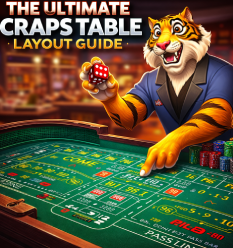
The standard casino craps table layout measures approximately 12 feet long and features a distinctive bathtub shape with padded rails. Every element serves a purpose, from the chip racks built into the rails to the mirrored betting areas on each end. Understanding this structure is your first step toward confident play.
A full-size table accommodates up to 16 players simultaneously, with eight positions on each side. The layout is intentionally symmetrical, allowing the crew to manage bets efficiently regardless of where you're standing. This design remains the industry standard because it simply works.
Look at the table from above, and you'll notice the left and right sections are identical twins. Each wing contains its own Pass Line, Come area, Field box, and numbered place bet boxes (4, 5, 6, 8, 9, 10). This professional craps table layout means no player has an advantage based on position.
The middle strip running down the table belongs to the stickman and houses all high-risk, high-reward wagers. Here you'll find the hardways, horn bets, and various one-roll propositions. These proposition bets carry the steepest house edge on the entire table, often exceeding 10%.
|
📍 Table section |
🎯 Primary bets |
⚠️ Risk level |
📊 House edge |
👤 Best for |
|
🎲 Pass Line area |
Pass/Don't Pass |
Low |
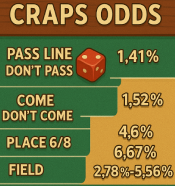
1.41% |
Beginners |
|
🎯 Come section |
Come/Don't Come |
Low |
1.41% |
Regular players |
|
💰 Field box |
Field bet |
Medium |
2.78-5.56% |
Quick action seekers |
|
🔢 Place numbers |
6, 8, 5, 9, 4, 10 |
Low-Medium |
1.52-6.67% |
Strategic players |
|
⚡ Center props |
Hardways, Horn, Any 7 |
High |
9.09-16.67% |
Thrill seekers |
The outer portions of the craps layout contain the most important bets for smart players. These areas offer reasonable craps odds and form the foundation of any solid betting strategy. Spend most of your time and money here if you want your bankroll to last.
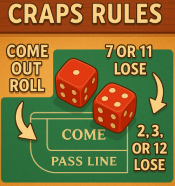
The pass line wraps around the outer edge of each wing like a highway, where most players begin their journey betting with the shooter to win. Directly above it sits the don't pass bar for contrarians who bet against the dice rolls. This wager pays even money and carries just a 1.41% disadvantage, making it one of the smartest bets in any casino.
Once a point established situation occurs, the Come and Don't Come boxes open for business. A come bet works exactly like a Pass Line wager but can be made after the initial roll. These boxes sit prominently in the center-left of each wing, giving you multiple opportunities to get money into play with favorable odds.
The large Field box stretches across the wing with numbers 2, 3, 4, 9, 10, 11, and 12 printed inside. This field bet resolves on every single throw, paying even money on most numbers and 2:1 or 3:1 on the 2 and 12. The quick resolution appeals to impatient players, though the house edge ranges from 2.78% to 5.56%.
Tucked into the corner near the Pass Line, these circular spaces offer even-money payouts if a 6 or 8 rolls before a 7. Experienced players avoid these entirely since placing the same numbers through the dealer pays 7:6 instead. The Big 6 and Big 8 exist mostly to trap uninformed bettors.
|
🎲 Bet name |
💵 Payout |
✅ How to win |
📈 Frequency |
💡 Strategy |
|
🎯 Pass Line |
1:1 |
7/11 come-out; point before 7 |
High |
Always use, add odds |
|
❌ Don't Pass |
1:1 |
2/3 come-out; 7 before point |
High |
Solid alternative |
|
🔄 Come |
1:1 |
Same as Pass after point set |
High |
Build multiple points |
|
💰 Field |
1:1 (2:1 on 2/12) |
2,3,4,9,10,11,12 roll |
Every roll |
Short sessions only |
|
6️⃣ Place 6/8 |
7:6 |
Number before 7 |
Medium |
Best place bets |
|
⛔ Big 6/8 |
1:1 |
6/8 before 7 |
Medium |
Avoid completely |
That strip of felt controlled by the stickman contains the most exciting and dangerous bets on the entire craps table layout explained in gambling mathematics. The payouts look fantastic on paper, sometimes reaching 30:1 or higher, but those impressive numbers hide brutal house advantages.
These craps table layout wagers live and die on a single throw of the dice. Bet the "Any Seven" and either a 7 appears immediately or you lose. While the instant gratification appeals to some players, the house edge on most one-roll bets exceeds 11%.
The hardways section lets you wager that a specific double will appear before either a 7 or the "easy" version of that number. For example, Hard 8 wins only when two 4s show, losing to any other 8 combination or any 7. These bets stick around for multiple rolls, with house edge running between 9% and 11%.
A horn bet covers 2, 3, 11, and 12 in one wager, splitting your chips four ways. Any of those numbers hitting pays according to that specific outcome. While fun occasionally, these layouts craps carry edges around 12.5%.
The World bet adds Any Seven to the Horn combination, covering five numbers total. "Yo-leven" refers specifically to the 11, paying 15:1 when those dice show 5-6. You'll hear "yo!" shouted constantly because saying "eleven" sounds too much like "seven."
|
🎯 Proposition bet |
💰 Payout |
📊 True odds |
📉 House edge |
⚠️ Risk factor |
|
7️⃣ Any 7 |
4:1 |
5:1 |
16.67% |
Highest edge |
|
🎲 Any Craps |
7:1 |
8:1 |
11.11% |
Deceptive |
|
🔴 Hard 6/8 |
9:1 |
10:1 |
9.09% |
7 comes often |
|
🟡 Hard 4/10 |
7:1 |
8:1 |
11.11% |
Hard to hit |
|
⚡ Yo (11) |
15:1 |
17:1 |
11.11% |
One-roll gamble |
Every craps table operates with a team of four employees working in perfect coordination. Knowing their roles helps you interact appropriately and ensures your bets get handled correctly. The crew wants you to have fun and will gladly answer questions during slow moments.
The boxman sits at the center of the table, directly across from the stickman, guarding the chip bank. This supervisor watches every bet placement, every payout, and every suspicious movement. They verify large payouts, settle disputes, and rarely speak to players but see everything.
Standing at the center of the table, the stickman controls the dice with a curved stick and manages all center bets. They push the dice to the shooter, announce results after each roll, and constantly hawk proposition bets with colorful calls.
Two dealers stand on opposite sides of the table, each responsible for one wing. They convert cash to chips, place and pay bets in their section, and position odds behind Pass Line wagers. Good dealers remember every player's betting preferences.
|
👔 Role |
📍 Position |
🎯 Responsibility |
💡 Player tip |
|
🏦 Boxman |
Center, seated |
Supervises, guards chips |
Address for disputes |
|
🎤 Stickman |
Center, standing |
Controls dice, calls results |
Listen for suggestions |
|
💼 Dealer (L/R) |
Wings, standing |
Pays/collects bets |
State bets clearly |
Understanding the puck is essential because it determines what bets are available and how the game flows. This simple marker transforms the entire dynamic of the table with a single flip.
The puck is a hockey-puck-sized marker with "ON" printed on one side (white) and "OFF" on the other (black). When OFF, it sits in the Don't Come betting area, signaling the come-out roll phase. Once a point gets established, the dealer flips it to ON and places it directly on that point number.
With the puck OFF, Pass Line and Don't Pass bets are live and new. With it ON, those initial bets are locked while odds and place bets become available. Watch the puck before placing any chips to know exactly what phase the game is in.
Some bets you handle yourself, others require dealer assistance. Knowing the difference prevents awkward moments and keeps the game moving smoothly for everyone at the table.
The betting area directly in front of you is your domain. Pass Line, Don't Pass, Field, and Big 6/8 wagers can all be placed by reaching out and setting your chips down yourself.
Anything beyond the Pass Line requires dealer involvement. Want to place the 6? Toss your chips to the center and say "Place the six." Adding odds behind your Pass Line bet? Hand chips to the dealer and say "Odds on my Pass Line."
Following proper table etiquette ensures smooth gameplay and respect from both staff and fellow players. These unwritten rules exist for practical reasons and have evolved over decades of craps tradition.
When you approach craps table layout, wait for the current roll to complete before placing cash down. Put your money on the layout and say "Change only" if you don't want an immediate bet. The dealer will slide chips back to you.
When the stickman pushes dice to the shooter, get your hands up and away from the table. Nothing ruins the vibe faster than dice hitting someone's fingers and bouncing off course.
Tipping isn't required but is customary. You can place a bet "for the boys" by putting chips on the Pass Line and announcing the tip. The crew remembers generous players.
|
⚡ Action |
✅ Do |
❌ Don't |
🎯 Why |
|
💵 Buying in |
Place cash on layout |
Hand to dealer |
Camera visibility |
|
🎲 Handling dice |
One hand only |
Two-hand dice |
Prevents cheating |
|
🙌 During rolls |
Keep hands up |
Reach over layout |
Unobstructed rolls |
|
🗣️ Placing bets |
Speak clearly |
Mumble/toss randomly |
Accurate placement |
Online and live dealer versions have made craps accessible to players who can't visit land-based casinos. The fundamental craps table layout with odds remains consistent across formats, though interaction differs.
Playing on your phone removes the intimidation factor completely. The digital craps table layouts display the same betting areas but let you click or tap to place wagers. Pop-up windows explain each bet, and you control the pace entirely without pressure from other players.
Live dealer games stream from real studios with actual dice and professional crew. The camera angles show the table clearly, and you place bets through an interface overlay. While lacking full physical atmosphere, live craps delivers authentic action from anywhere in the USA.
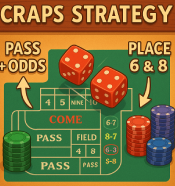
Smart craps strategy comes down to geography on the felt. Where you put your money determines your expected return. The craps layouts tell you everything about risk if you learn to read them properly.
The safest bets cluster around the outer edges. Pass Line and Don't Pass at 1.41% form the foundation. Adding free odds reduces the overall edge further. Place 6 and Place 8 at 1.52% round out the smart money zones.
💡 Maximize your odds bets whenever possible. Free odds pay true probabilities with zero house advantage.
The center section exists to generate profit for the casino. Those flashy payouts on hardways fund the building and staff salaries. Occasionally dropping $5 on a hard 8 is fine, but making center bets your regular strategy guarantees losses.



























































.png)













 slots.png)










.png)











.png)












.png)






























.png)