





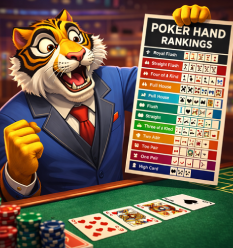
Ultimate Texas Hold'em puts you against the dealer using standard poker hand rankings — no bluffing, no reading opponents. Your edge comes entirely from knowing when to raise 4×, when to wait, and when to walk away. This guide breaks down every decision point with real math, so you stop guessing and start playing with purpose. The Ultimate Texas Hold'em strategy chart is your roadmap from the first bet to the final river call.
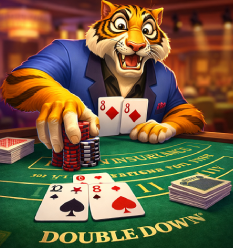
Ultimate Texas Hold'em (UTH) is a house-banked poker variant where you compete solely against the dealer. Both sides get two hole cards, and five community cards are dealt in flop-turn-river format. Your job is to build a stronger five-card hand than the dealer's.
Standard poker rewards bluffing and psychological reads. UTH removes all of that — hole card knowledge and bet timing are the only tools you have. There are no other players to outmaneuver, just you and the math.
Every hand starts with two mandatory wagers — blind and ante — placed in equal amounts. The Ante pays even money on a win, while the Blind only pays on a straight or better. This structure punishes passive play and rewards players who hold strong hands from the start.
The biggest player edge in UTH comes from raising 4× pre-flop with the right hands. Your Play bet becomes four times your Ante before any community cards appear. Getting this timing right is what the Ultimate Texas Hold'em strategy chart is built around.
UTH has three decision points — pre-flop, flop, and river. You can only place one Play bet per hand, so choosing the right moment directly affects your long-term results.
Before community cards are dealt, you can raise 3× or 4× your Ante, or simply check. Most optimal strategies default to 4× or check, since 3× rarely offers a mathematical advantage. The Ultimate Texas Hold'em preflop strategy chart lists exactly which hands justify an immediate raise.
Players who checked pre-flop can place a 2× bet after the flop. If you've connected with the board — two-pair, trips, or a solid draw — betting 2× is correct. Miss entirely and you check again, waiting for the river.
The final choice is simple: bet 1× or fold. Folding costs you both the Ante and Blind immediately, so the threshold for folding is higher than most players expect. Any live pair is almost always worth a 1× call.
Dealer qualification requires the dealer to hold at least a pair. Without it, your Ante pushes and your Play bet wins even money. This rule cuts the effective house advantage noticeably, since unqualified dealer hands occur in roughly one out of every four rounds.
Did you know:
The dealer fails to qualify roughly 1 in every 4 rounds in UTH — when that happens, your Ante pushes and Play bet wins automatically. Qualification odds matter!
The pre-flop raise decision carries more weight than any other moment in UTH. Raising 4× with the right hands — and checking with the wrong ones — is the foundation of the Ultimate Texas Hold'em optimal strategy chart.
Hand category 🃏 |
Specific hands 🎴 |
Action 🎯 |
Reasoning 📊 |
Any Ace ♠ |
A2o through AKs |
Raise 4× ✅ |
Strong blocker value; wins most showdowns |
Strong kings 👑 |
K5s+, K9o+ |
Raise 4× ✅ |
Solid equity against dealer range |
Weak kings ♣ |
K2s–K4s |
Check ❌ |
Too dominated pre-flop |
Strong queens 💎 |
Q8s+, QTo+ |
Raise 4× ✅ |
Good board connection potential |
Weak queens ⚠️ |
Q2o–Q7o |
Check ❌ |
Poor pre-flop equity |
Mid-high pairs 🎰 |
33 and higher |
Raise 4× ✅ |
Set potential plus immediate pair value |
Low pairs 🔻 |
22 |
Check ❌ |
Marginal — better to see the flop first |
An Ace in your hand removes the dealer's strongest kicker combinations from the equation. Optimal raising with any Ace — regardless of the second card — is backed by every published UTH strategy model. The long-run equity is positive even when paired with a deuce.
Kings need at least a 9 offsuit or a suited 5 to justify a 4× raise. Queens require a Ten offsuit or an 8 suited as a minimum. Anything below those thresholds means checking and reassessing once the flop lands.
Strategy Tip:
Always raise 4× with any Ace — even Ace-2 offsuit. Checking an Ace pre-flop is the single most costly mistake UTH players make. Never slow-play it!
The flop opens a second window to put money in with an edge. Players who missed the pre-flop raise still have a shot at a profitable 2× bet — but only when the board connects. The Ultimate Texas Hold'em basic strategy chart covers every flop scenario clearly.
Any time your best five cards using the flop make two-pair or better, the 2× bet is mandatory. Full houses, trips, straights — all of them warrant committing chips here. The math clearly favors action when you're already ahead of most dealer distributions.
Open-ended straight draws lean toward a 2× bet only when your hand also holds overcards to the board. Flush draws follow the same logic. A draw alone — with no pair and no overcards — doesn't justify a 2× bet.
If your hole cards include a card the dealer needs to complete a strong hand, that blocking effect slightly improves your 2× bet equity. It's a minor edge, but worth factoring in when the decision is borderline.
The Ultimate Texas Hold'em strategy chart trips side bet pays based on your final hand strength alone — the dealer's result doesn't matter. Higher hands pay more, and a Royal Flush can return 50:1 or better. Before diving into the pay table, note that the Blind bet operates separately: it only activates on a straight or better, which is why it doesn't lose when the dealer fails to qualify.
Hand 🃏 |
Blind bet payout 💰 |
Trips bet payout 🎰 |
Royal flush 👑 |
500:1 |
50:1 |
Straight flush ♠ |
50:1 |
40:1 |
Four of a kind 🔥 |
10:1 |
30:1 |
Full house 💎 |
3:1 |
8:1 |
Flush ♣ |
3:2 |
7:1 |
Straight ➡️ |
1:1 |
4:1 |
Three of a kind ✅ |
Push |
3:1 |
Two pair ⚠️ |
Push |
— |
Pair or less ❌ |
Loss |
— |
The Trips side bet carries a house advantage ranging from 1.9% to 6.8% depending on the casino's pay table. At Lucky Tiger casino, always confirm which pay table is active before committing to this bet regularly. Short sessions make it entertaining; long sessions make it costly.
UTH swings hard. Three consecutive 4× losing hands can wipe out a session budget that looked comfortable five minutes earlier. Planning your buy-in around this variance is what keeps you at the table long enough for optimal strategy to pay off.
Arrive with at least 50 betting units. At a $5 Ante, that's $250. Each fully committed hand — Ante + Blind + 4× Play — costs 6 units, so you need enough depth to survive a rough stretch without abandoning your play or fold decisions mid-hand.
The volatility comes from the high-commitment nature of 4× pre-flop raises. Losing several in a row feels alarming, but those raises carry positive expected value when made correctly. The swings are built into the game structure, not a signal to change your approach.
Lucky Tiger Casino offers reload bonuses that extend your effective session length. A $100 bonus gives you more hands to run optimal strategy, reducing your net exposure to the house edge over time. Always check wagering requirements before applying any bonus to casino table games.
Most UTH losses come from the same repeating errors. Recognizing them is the fastest way to tighten your game.
Checking an Ace pre-flop feels safe but it's a clear mathematical error. You forfeit the 4× raise on a hand that wins the majority of showdowns. Players who consistently slow play Aces give back more per hour than almost any other single mistake.
Folding is only an option on the river — but mentally surrendering before that point leads to passive 1× calls that should have been confident bets. Any live pair justifies a call, especially when dealer qualification may reduce your actual risk.
Attention:
Never fold before the river in UTH — folding forfeits both Ante and Blind immediately. Any live pair, even a pair of twos, is almost always worth a 1× call!
A pair of Twos is technically a made hand, but against a K-Q-J board the dealer is almost certainly ahead. A 1× call is still mathematically correct due to hand strength and qualification odds — just don't mistake "correct call" for "strong position."

















































.png)













 slots.png)










.png)











.png)











.png)























.png)