






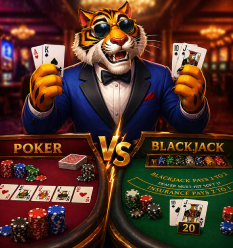
When it comes to Blackjack vs Poker, most players think they already know which game takes more skill. But the real answer is more nuanced than you'd expect. These two games sit on opposite ends of the card game spectrum, one governed by math and memory, the other by psychology and strategy. This guide breaks down both paths so you can decide which one fits your playing style at Lucky Tiger Casino in 2026.
Every card game puts you in one of two situations: you're either fighting a fixed system or a living, breathing opponent. That single distinction changes everything about how skill gets applied and rewarded.
Blackjack is a player vs house (PvE) game. The casino sets the rules, the probabilities are fixed, and your job is to find the mathematically correct response to every situation. There's no opponent to read, no table dynamic to exploit. You're solving a puzzle with a known answer. Poker flips that entirely. It's player vs player (PvP), where the opponent is human, unpredictable, and just as capable of making mistakes as you are. Every decision you make is relative to the people sitting across from you, not a predetermined rule set.
A solved Blackjack vs Poker game is one where perfect play can be calculated and defined. Blackjack comes very close to that definition. Basic strategy charts eliminate almost all guesswork, and counting adds a measurable edge on top. There is a ceiling to what skill can accomplish here. Poker has never been fully solved, and even advanced solvers can only approximate ideal play. The game evolves with every opponent, every session, and every year. That open-ended nature is exactly what draws serious competitors to the table.
Blackjack rewards a very specific type of intelligence: pattern recognition, discipline, and the willingness to follow a system without deviation. It's a game where emotion is your enemy and the math chart is your best friend.
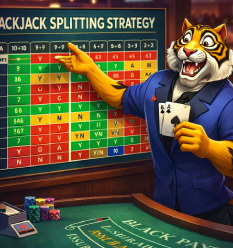
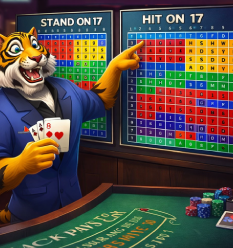
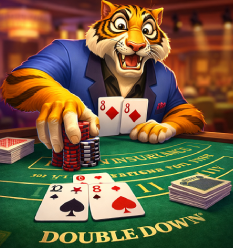
Basic strategy is the mathematically optimal way to play every hand based on your cards and the dealer's upcard. It has been solved using computer simulations and covers every possible scenario. Following it reduces the house edge to around 0.5%, which is remarkably low for any casino game. The catch is that it leaves almost no room for creativity. Decision-making impact in Blackjack is binary: stick to the chart and minimize losses, or deviate and hand the casino a larger edge. There is no middle ground.
Did you know:
Basic strategy reduces Blackjack house edge to ~0.5%, while skilled card counting can shift the edge about 1–2% in the player’s favor.
Card counting takes the skill ceiling a step further. By tracking the ratio of high to low cards remaining in the shoe, a skilled counter can shift the edge in their favor by 1 to 2%. That's real money over thousands of hands, and it's exactly why casinos invest heavily in countermeasures. Deviations from the base chart, based on the running count, add another layer of precision. These are memorized index numbers that tell you when to play differently than standard. It takes months of practice to apply them accurately under casino conditions.
Even the best Blackjack player in the world can only extract so much from the game. Once you've mastered counting and optimal play, you've hit the ceiling. There's no deeper level to unlock and no psychological battle to win. This is what players mean by the "perfect play" ceiling. It's not a criticism of Blackjack as a game, it's simply a structural reality. The game was built around math, and math has a final answer.
Poker operates in an entirely different dimension. The skills required overlap with Blackjack in some areas but extend far beyond it in scope and complexity. Mastery in Poker is a lifelong pursuit, not a destination.
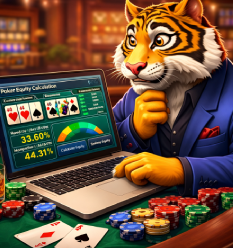
The math in Poker starts with pot odds, which measure whether a call is profitable given the current pot size. From there it expands into expected value calculations, equity distributions, and eventually game theory optimal (GTO) frameworks that define unexploitable strategies. GTO models were developed using AI solvers and represent a mathematically balanced approach to the game. A GTO player has no single exploitable leak. Most high-level players combine GTO foundations with exploitation-based adjustments depending on the opponent at the table.
Strategy Tip:
Combine GTO fundamentals with exploitative play in Poker: GTO minimizes losses, while exploiting weak opponents drives consistent profit.
Bluffing and psychology are what separate Poker from every other card game. A mathematically sound player who can't read opponents or control their own emotional tells will still leak chips over time. Reading behavioral cues, known as tells, is an acquired skill that takes years to refine. A well-timed bluff is a calculated bet on the opponent's likely response, based on board texture, betting history, and player tendencies. Tournament play amplifies these dynamics because the blinds escalate and every chip carries survival value.
Unlike Blackjack, Poker has no ceiling. Even the best players in the world are still learning, still adjusting their models as solver data evolves and player pools shift. You can always study more spots, refine your ranges, or improve your mental game. Long-term profitability in Poker depends not just on knowing math but on being better than the people you're playing against. That's a moving target, and it never stops moving.
Both games involve luck in the short run. But how much luck, and for how long, differs significantly. Understanding variance helps set realistic expectations for anyone looking to play seriously. Blackjack vs Poker odds look very different when measured over sample sizes. In Blackjack, results normalize quickly because every hand is close to a 50/50 proposition with correct play. In Poker, swings can last months even for winning players.
|
Feature |
Blackjack 🃏 |
Poker (Texas Hold'em) ♠️ |
Strategic implication 💡 |
|
Skill type |
📐 Math and memory |
🧠 Psychology and math |
Different skill sets required |
|
Opponent |
🏦 The house |
👥 Other players |
Changes win conditions |
|
Skill ceiling |
⛰️ Fixed |
♾️ Unlimited |
Poker rewards long study |
|
Short-term luck |
🎲 Moderate |
🎲 High |
Larger bankroll needed for Poker |
|
Edge possible |
📊 1-2% (counting) |
📈 5-30%+ |
Higher edge in Poker |
|
Countermeasures |
🚫 Casinos ban counters |
✅ Legal to play professionally |
Blackjack riskier long-term |
|
Time to learn basics |
⏱️ One evening |
📅 Months to years |
Entry barrier very different |
Variance in Poker is tied to the number of decision points per hand and stack-to-pot ratios involved. A single big pot can represent hours of accumulated edge. That demands a larger bankroll and stronger emotional discipline than most beginners expect.
Bonus insight:
Poker variance can last months, so keep a bankroll of 20–30 buy-ins before playing serious stakes.
The Poker vs Blackjack environment for professional card players has changed significantly over the past decade. Technology, regulation, and player pool dynamics all shape how viable each game is as a source of consistent income.
Poker solvers have transformed how serious players study the game. Tools based on GTO allow players to analyze any hand situation and find the theoretically optimal response. Today's top players spend hours off the table reviewing solver outputs, building range charts, and identifying leaks in their own play.
This has raised the average skill floor substantially. Games that were once beatable with basic fundamentals now require understanding where your edge comes from, whether that's exploiting recreational players or winning theoretical battles against regulars. The Poker vs Blackjack odds of finding a profitable game have shifted accordingly.
Counting cards is not illegal, but casinos treat it as a threat and respond aggressively. Modern surveillance systems use facial recognition, betting pattern analysis, and AI tools to identify suspected counters faster than ever before. When flagged, players are typically banned from the property. A professional Blackjack counter has to constantly find new venues, disguise their methods, and operate under the radar. In 2026, that's harder than it's ever been. The Blackjack vs Poker debate for professional play increasingly tilts toward Poker because no casino can ban you simply for playing well.
Attention:
Card counting is legal, but casinos may detect and ban suspected players immediately, often without warning.
Choosing between these games comes down to what kind of challenge you enjoy and what income model you're willing to commit to. Neither path is easy, but they suit very different personality types.
For players at Lucky Tiger Casino who want to maximize their edge, Poker offers more long-term upside. The skill ceiling is higher, the edges are larger, and the game rewards you for outplaying people rather than outsmarting a surveillance camera.



























.png)









 slots.png)










.png)










.png)










.png)













.png)