




Sitting at a poker table for the first time feels like walking into a conversation in another language. Players toss around terms like "3-bet," "nuts," and "tilt" without explanation, leaving newcomers completely lost. This guide serves as your complete dictionary of poker slang — every term explained clearly so you can follow strategy discussions, live dealer chats, and tournament broadcasts with confidence. Master these expressions and you'll communicate like a seasoned regular at any table on luckytigercasino.com. 🃏
Core actions form the backbone of every hand, and knowing these poker terms lets you follow the casino game without confusion. These are the moves you'll see and hear every single round, whether playing online or live.
A flat call means matching the current bet without raising, often to disguise hand strength. A cold call refers to calling a raise when you haven't invested anything in the pot yet during that round — it requires a stronger holding. A snap call is an instant call without hesitation, typically signaling extreme confidence in a hand.
In poker, the initial raise is the "2-bet," a re-raise over it is the "3-bet," and another raise on top becomes the "4-bet." Light 3-betting means re-raising with non-premium hands to pressure the original raiser. The higher the bet number, the narrower ranges typically become, so a 4-bet almost always represents serious strength or a very bold bluff.
A donk lead occurs when a player who wasn't the preflop aggressor bets out first on the flop — the name sounds harsh, and it often describes a mistake. A check-raise is the opposite approach: you check, let someone else bet, then raise over them. Both moves influence control over the river and every street that follows, and skilled players use each deliberately.
Experienced players never say "I have a good hand." Instead, there's an entire vocabulary for hand strength, and learning these card terms poker veterans use daily helps you decode any hand discussion instantly.
The nuts means the absolute best possible hand given the board — unbeatable in that moment. The second nuts is the second-best holding, which feels incredible until someone tables the actual best hand. Many legendary pots involve a player with the second nuts running into the stone-cold winner.
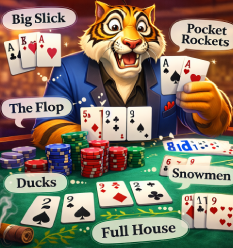
Pocket rockets is the universal nickname for a pair of aces — the strongest starting hand. Cowboys refers to pocket kings, the second-best starter, while fishhooks describes pocket jacks — powerful but vulnerable to overcards. These nicknames have been part of the culture for decades and appear in every poker room conversation.
Suited connectors are two same-suit cards in consecutive rank, like 7♠ 8♠, capable of making both straights and flushes. Gappers have a gap between ranks — like 6♠ 8♠ — making straights harder to complete. Aggressive players favor these speculative hands when they have position.
"Air" means your hand holds absolutely zero value — no pair, no draw, nothing. A pure bluff is betting with air, relying entirely on your opponent folding. Bluffing with nothing takes precise timing and reads, especially against opponents who rarely surrender pots.
Every table features a mix of playing styles, and regulars quickly label each opponent using shorthand. Recognizing these poker phrases for archetypes helps you adjust strategy on the fly. Understanding the dynamic between fish and sharks defines your approach to any session.
|
Slang term |
Player description |
Playing style |
How to counter |
|
🐟 Fish |
Inexperienced, weak player |
Calls too much, chases draws |
Value bet heavily, avoid bluffing |
|
🦈 Shark |
Highly skilled, dangerous |
Aggressive, exploitative |
Tighten up, avoid marginal spots |
|
🐴 Donkey |
Makes consistently poor choices |
Overplays weak hands |
Be patient, let them self-destruct |
|
🔒 Nit |
Extremely tight, passive |
Only premium hands |
Steal blinds, fold to their raises |
|
⚙️ Grinder |
Disciplined, steady volume |
Small edges over long sessions |
Mix up play, deny easy value |
|
🐳 Whale |
Wealthy recreational player |
Loose, careless with money |
Play straightforward, maximize value |
Dramatic swings define the poker experience, and each memorable moment has its own name. These poker sayings capture the emotional rollercoaster of the game in just a few words.
A bad beat happens when a heavy favorite loses to an underdog through unlikely cards hitting the board. A suck out is the flip side — a trailing player catches their miracle card to steal the pot. Every player carries bad beat stories, and sharing them is practically a tradition.
Going on tilt means letting frustration dictate your decisions — chasing losses, making reckless calls, abandoning strategy. Steaming is a more extreme version where a player visibly hemorrhages chips while emotionally compromised. The best defense against tilt is a predetermined stop-loss rule: hit your limit, walk away without exceptions.
The bubble is the most tense phase of tournament play — one elimination separates everyone from paid positions. Once the bubble player busts, the rest are in the money (ITM). Strategy shifts dramatically here: short stacks get desperate, big stacks bully, and being on the button gives you maximum leverage to apply pressure.
Running hot means catching premium hands and winning consistently over a stretch. Card dead is the opposite — sitting through hours of unplayable garbage like 7-2 and 8-3. Both streaks are temporary, and your job is making optimal decisions regardless of recent results.
Modern poker vocabulary extends into math and theory, and these poker words form the foundation of serious strategy. Grasping these concepts separates casual players from those who genuinely improve.
Equity represents your share of the pot based on win probability — 60% chance in a $100 pot means $60 in equity. Fold equity is the added value when your aggression forces opponents to surrender. Combining both types of equity is what transforms a recreational player into a disciplined grinder at the tables.
Outs are remaining cards that improve your hand to a likely winner — nine outs for a flush draw after the flop, for instance. Dirty outs improve your hand but may improve an opponent's hand even more. Getting pot-committed when you're counting mostly dirty outs is a common and expensive mistake.
A range is the full collection of hands a player might hold in a given spot — strong players think in ranges, not specific holdings. A polarized range contains only very strong hands or pure bluffs, with nothing in between. Recognizing polarized ranges improves calling decisions and helps you understand why slow rolling is so frowned upon — the hand is often more uncertain than it appears.
Beyond individual terms, poker slang features common expressions that surface in commentary, strategy content, and table chat. These compact phrases each tell a story efficiently. Familiarizing yourself with this quick reference covers the most essential phrases you'll encounter regularly.
|
Phrase |
Meaning |
Example scenario |
|
🏃 "Hit and run" |
Winning big then leaving immediately |
Doubling up and cashing out within minutes |
|
🧊 "Cooler" |
Losing a great hand to a better one |
Aces full vs. quads — nobody escapes this |
|
📦 "Ship it" |
Pushing all-in or celebrating a win |
"Flopped the nuts — ship it!" |
|
🪤 "Trap" |
Hiding strength to extract value |
Checking aces preflop to invite a raise |
|
🌊 "Floated" |
Calling in position planning to bluff later |
Calling flop with nothing, betting the turn |
Knowing the vocabulary transforms your entire experience — from confused spectator to confident participant. When you understand the language, absorbing strategy content and engaging with fellow players becomes natural.
Live dealer tables feature active chat where players comment in real time using shorthand. Phrases like "nice suck out" or "brutal cooler" fly by constantly, and recognizing them instantly lets you participate in the community. At Lucky Tiger, fluent table talk makes every session more social and engaging.
Poker education in 2026 assumes familiarity with specialized vocabulary throughout video lessons, written guides, and forum threads. If "light 3-bet against a nit's opening range" reads like gibberish, applying the lesson becomes impossible. Building your poker terminology foundation is the single fastest way to accelerate improvement.































































.png)
















 slots.png)










.png)










.png)












.png)






























.png)