







Understanding blackjack card values is the foundation of every winning session at the table. Whether you're sitting down for your first hand or need a refresher on how scoring works, this guide breaks everything down in plain English. We'll cover how numbered cards, face cards, and the mighty Ace contribute to your hand total. By the end, you'll know exactly how to count your points and avoid busting when you play at Lucky Tiger casino. 🃏
Every card in the deck carries a specific point value, and your goal is simple: get as close to 21 points as possible without going over. The dealer follows the same rules, but you're trying to beat their total. Once you understand how to play blackjack card values, the rest of the game clicks into place naturally.
These are the easiest to remember because they're worth exactly what they show. A 2 is worth 2 points, a 7 is worth 7 points, and a 10 is worth 10 points. There's no trick here—what you see is what you get.
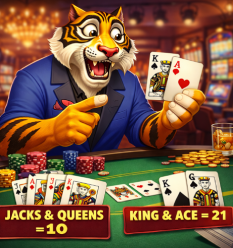
All face cards carry a point value of 10 regardless of their suit or royal status. A Jack of Spades has the exact same weight as a Queen of Hearts or King of Diamonds. This means roughly 30% of any standard deck of cards consists of 10-value cards.
The Ace can count as either 1 or 11 points depending on what blackjack card values benefits your hand most. This dual nature creates the concept of soft hand and hard hand distinctions. The Ace's flexibility gives players extra breathing room that no other card provides.
|
Card type 🎴 |
Card faces |
Point value 🔢 |
Role in the game 🎯 |
|
Numbered |
2️⃣-🔟 |
Face value (2-10) |
Foundation of most hands |
|
Face cards |
👑 J, Q, K |
10 points each |
High-value building blocks |
|
Ace |
🅰️ |
1 or 11 |
Flexible game-changer |
The Ace is where newcomers often get confused, but it's actually designed to help you. This card automatically adjusts its value to give you the best possible hand. Learning blackjack card values ace rules will immediately improve your confidence at the table.
You never have to "call" your Ace as 1 or 11—the game handles this automatically. If counting the Ace as 11 keeps you at or under 21, it stays at 11. The moment that would push you over 21, the ace high low value flips to 1 seamlessly.
Paired with any 10-value card, an Ace delivers an instant natural blackjack—the best hand possible. Even without hitting 21 immediately, an Ace gives you protection against busting on your next draw. You can swing aggressively knowing that your Ace will convert to 1 if needed.
A soft hand contains an Ace currently counted as 11, giving you flexibility to hit without bust risk. A hard hand either has no Ace or contains an Ace forced to count as 1. This distinction changes your basic strategy completely—soft hands allow aggressive play while hard hands require caution. 💡
|
Hand combination 🃏 |
Total points |
Hand type |
Risk on next hit ⚠️ |
|
A + 6 |
17 (or 7) |
✅ Soft |
Zero risk |
|
A + 9 |
20 (or 10) |
✅ Soft |
Zero risk |
|
A + 5 + 7 |
13 |
❌ Hard |
Medium risk |
|
10 + 7 |
17 |
❌ Hard |
High risk |
The face cards—Jacks, Queens, and Kings—form the high-value backbone of the deck alongside the 10s. Understanding their role is key to mastering black jack card value calculations and making smarter decisions.
From a scoring perspective, there's absolutely no difference between these cards. A 10 of Clubs equals a King of Spades equals a Queen of Hearts—all worth exactly 10 points. The artwork changes, but the mathematics stays constant.
In a standard 52-card deck, exactly 16 cards carry a value of 10—that's roughly 31%. This high concentration affects every strategic decision, from hitting on 11 to standing on 12 against weak dealer cards. Card counting systems weight 10s heavily because of this dominant presence.
Receiving two 10-value cards gives you a starting hand total of 20—an extremely strong hand. While rules allow splitting any pair, dividing two 10s is universally considered a mistake. You're trading a near-certain winner for two uncertain hands, so always stand on 20.
Your blackjack card values hand total determines whether you win, lose, or push against the dealer. The magic number is 21—get there and you're golden, but exceed it and you've lost instantly regardless of what the dealer holds.
A natural blackjack occurs when your first two cards total exactly 21—an Ace paired with any 10-value card. This unbeatable combination pays better than a standard win and defeats any dealer total except another natural. The term "natural" distinguishes this from reaching 21 with three or more cards.
Traditional blackjack card values tables pay 3:2 for a natural, meaning a $10 bet returns $15 profit. Some tables offer only 6:5 payouts, reducing that same bet to just $12 profit. At Lucky Tiger, always check table rules—avoid 6:5 games whenever possible as they significantly increase the house edge.
A bust happens when your total exceeds 21, resulting in automatic loss regardless of the dealer's cards. Your bet disappears immediately and the hand ends. The risk of busting influences every hit or stand decision, especially with totals between 12 and 16.
Knowing point values means nothing without applying them strategically. Your starting total combined with the dealer's upcard dictates your optimal move. This is where blackjack card values explained knowledge transforms into winning decisions.
With totals between 17 and 20, your strategy is simple: stand. These hands win frequently without improvement, and bust risk outweighs any potential gain. Even a 17 should never take another card because only four cards (A-4) help you.
Low totals give you freedom since busting is impossible. With 11, almost always double down—there's no risk and huge upside catching a 10. Hands totaling 5-8 typically call for hitting until you reach at least 12.
These totals create the toughest decisions—too low to stand confidently, too high to hit safely. Against dealer 2-6, standing often makes sense as they're likely to bust. Against dealer 7-Ace, hitting becomes necessary despite the risk.
|
Starting total 🎯 |
Dealer shows 🃏 |
Action ▶️ |
Win rate 📊 |
|
11 |
Any |
Double ⬆️ |
~67% |
|
16 |
7-A |
Hit |
~42% |
|
16 |
2-6 |
Stand |
~48% |
|
12 |
2-3, 7-A |
Hit |
~45% |
New players sometimes wonder if the four suits carry different weights. In standard play, the answer is straightforward—suits are irrelevant to your score.
For basic scoring, suits are completely irrelevant. A King of Spades equals a King of Hearts in every way. Your hand total calculation ignores suit entirely, focusing only on the numerical value of each card.
Some tables offer optional side bets paying bonuses for suited combinations—like getting blackjack with matching suits. These side bets typically carry higher house edges than the main game, so approach them as entertainment rather than strategy.
While core scoring remains consistent, certain game variations tweak rules in ways that affect card value importance. Understanding these differences helps you adapt your approach at Lucky Tiger.
Spanish 21 removes all four 10s from the deck while keeping face cards. This dramatically reduces natural blackjack frequency and alters the math behind every decision. The game compensates with bonus payouts and player-friendly rules.
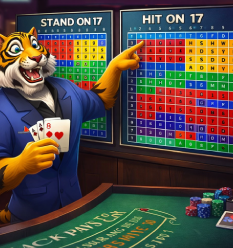
Games where the dealer must stand on soft 17 favor players more than hit-soft-17 games. Restrictions on doubling or splitting affect how profitably you can use high-value cards. Always review specific table rules before playing.
Misunderstandings about how cards work lead to costly mistakes. Let's clear up the most persistent myths.
Some players believe you must announce your Ace's value when dealt—completely false. The Ace automatically takes whatever value helps most, adjusting as new cards arrive. You never need to declare anything.
After several low cards appear, some feel a 10 must come next. This gambler's fallacy ignores reality—each draw is independent. Casual assumptions about cards being "due" lead to poor decisions based on feelings rather than odds.






















































.png)















 slots.png)










.png)












.png)












.png)































.png)